Miami is entering a new stage of transportation. Autonomous vehicles are no longer just an idea. They are now being tested and introduced on city streets. While most people focus on the vehicles, the real foundation works quietly in the background. That foundation is LiDAR mapping, and it plays a much bigger role than many realize.
Self-driving vehicles do not rely on guesses. They depend on clear and accurate data that shows exactly where they are and what surrounds them. In a busy and fast-changing city like Miami, this level of detail only comes from LiDAR mapping.
Miami’s autonomous vehicle rollout is really about accuracy
Autonomous vehicles use sensors, software, and maps together. Cameras and radar help detect movement. However, maps give meaning to what those sensors see. Without accurate maps, even advanced systems struggle.
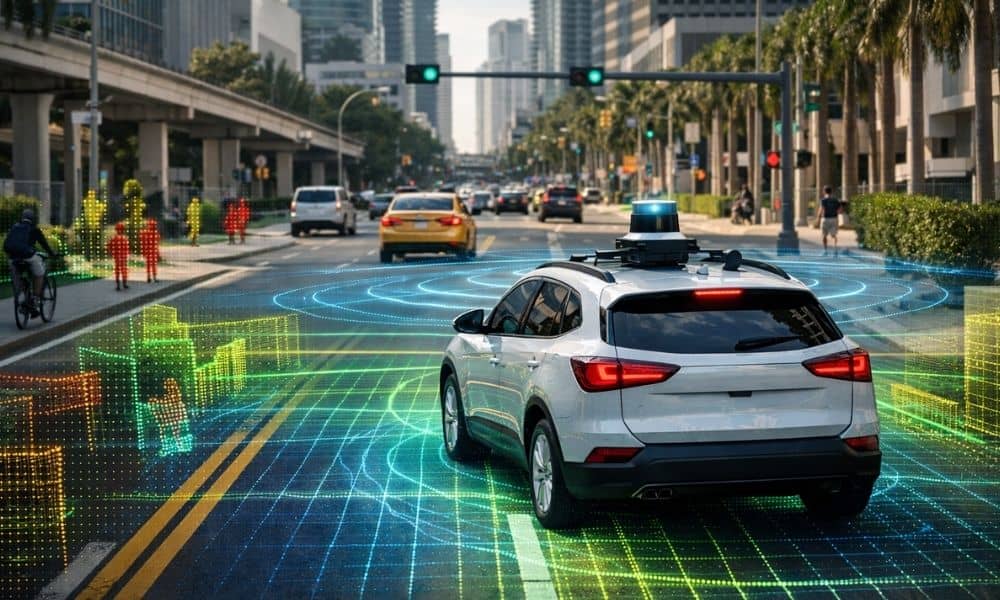
LiDAR mapping creates detailed 3D models of streets, intersections, and fixed objects. These models show exact distances, shapes, and elevations. As autonomous vehicles drive through Miami, they compare what their sensors see to these maps in real time.
By allowing autonomous vehicles on its roads, Miami shows that it trusts this level of accuracy. In simple terms, LiDAR mapping is now essential, not optional.
Why Miami is a difficult city for autonomous vehicles
Miami presents challenges that many other cities do not.
First, streets change often. Construction zones appear quickly. Lane markings shift. Barriers move. Even so, the core road layout must stay accurate for vehicles to move safely.
Second, pedestrian traffic stays high all year. Tourists, cyclists, delivery drivers, and rideshare vehicles fill the streets. Autonomous vehicles must know exactly where curbs and sidewalks are before reacting to people nearby.
Third, weather affects visibility. Rain, glare, and reflections from buildings can confuse cameras. LiDAR mapping provides a steady reference that does not depend on lighting. This makes navigation more reliable in changing conditions.
Because of these factors, Miami requires higher mapping precision than many other cities.
How LiDAR mapping supports city-wide navigation

LiDAR mapping for autonomous vehicles focuses on the full driving environment, not just single locations.
It captures road width, lane position, curb height, medians, and vertical clearance. It also records fixed objects like poles, barriers, and bridge edges. Autonomous vehicles use this information to confirm their exact position on the road.
When a vehicle approaches an intersection, the map already knows the layout. When it turns, the map confirms how sharp the turn should be. This reduces sudden movements and improves safety.
In Miami, where roads sit close together and traffic stays heavy, this consistency keeps vehicles steady and predictable.
Autonomous vehicles rely on pre-mapped environments
Many people think autonomous vehicles react only to what they see. In reality, they rely heavily on pre-mapped data.
LiDAR maps act as a trusted guide. Sensors then confirm what the map already shows. This reduces uncertainty and helps vehicles make faster decisions.
For example, when a vehicle knows the slope of the road ahead, it brakes more smoothly. When it knows where the curb is, it avoids overcorrecting. These small details improve safety, especially in crowded areas.
LiDAR mapping gives autonomous vehicles confidence. In Miami, that confidence allows them to operate alongside human drivers.
What this shift says about Miami’s infrastructure
The use of autonomous vehicles sends a clear message. Miami now treats accurate spatial data as part of its core infrastructure.
To support these systems, the city must maintain reliable roadway layouts, elevation data, and reference points. This same data supports transportation planning, utilities, and long-term growth.
Autonomous vehicles make this change visible. The deeper shift is how Miami now values precise mapping as a foundation for modern systems.
Why this matters to developers and property owners
Even outside transportation, this shift affects development and planning.
As mapping standards rise across the city, expectations rise as well. Developers and engineers must work with accurate data that matches public infrastructure. Projects based on rough assumptions create risk.
For property owners, this trend shows how closely land, roads, and infrastructure connect. While autonomous vehicles may not impact every project directly, the data behind them shapes how the city grows.
LiDAR mapping is becoming foundational
Autonomous vehicles highlight how important accurate mapping has become. They are not the only system that relies on it, but they make its value easy to see.
LiDAR mapping now supports transportation, infrastructure planning, and future development across Miami. As more smart systems arrive, they will depend on the same level of detail.
This makes LiDAR mapping more than a technology upgrade. It has become a foundation for the city’s future.
Final thoughts
Miami’s autonomous vehicle rollout reveals an important truth. New technology only works when the data behind it is reliable.
LiDAR mapping provides that reliability. It helps autonomous vehicles move safely and supports how the city plans for growth. While self-driving cars attract attention, LiDAR mapping quietly supports the systems that make modern cities function.
As Miami continues to grow, accurate mapping will remain one of its most important tools.