You’ve probably heard that lidar mapping is fast and accurate. That part is true. It can scan a site in hours and collect a huge amount of data. Because of that, many people assume the job is done once the scan is finished.
That’s where things go off track.
Lidar mapping gives you raw data. It does not give you a finished survey. If no one reviews and cleans that data, it can slow your project down instead of helping it.
What You Actually Get From Lidar Mapping
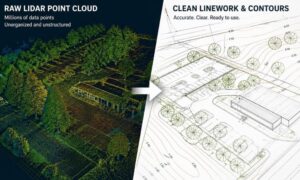
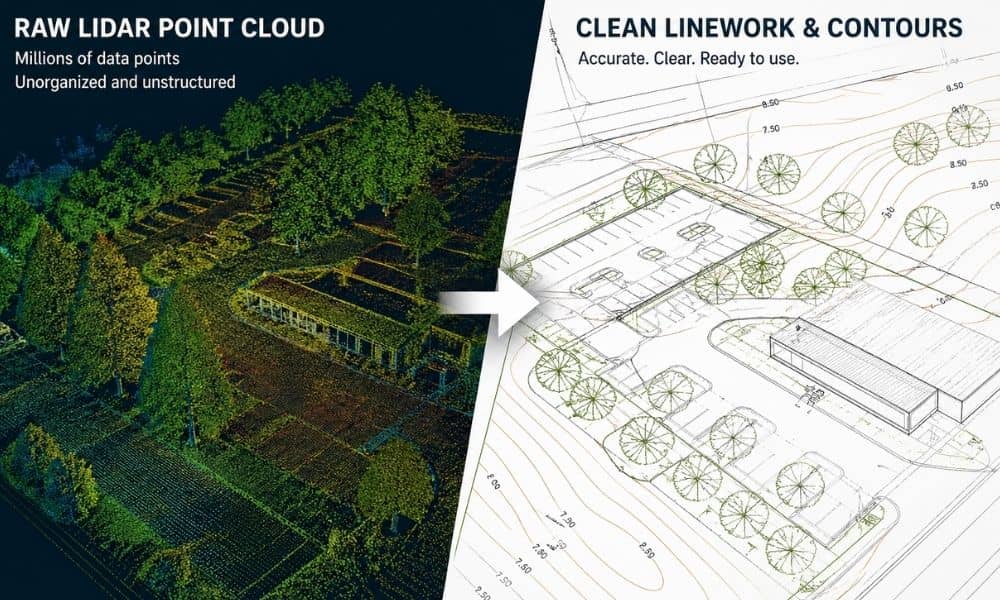
Lidar mapping sends out laser pulses and records where they hit. The result is a “point cloud.” That means millions of tiny dots that show the surface of the land.
At first glance, it looks impressive. You can see the ground, buildings, trees, even small changes in height.
But there’s a problem.
Those dots are not organized. They don’t show clear edges. They don’t tell you where a road ends or where a slope begins. They don’t label anything.
So yes, you get a lot of data. But you don’t get something you can build from.
Why Raw Data Slows Projects Down
Engineers and designers don’t work straight from point clouds. They need clean drawings they can actually use.
That usually means turning lidar mapping data into something ready for site design.
They need clear contours, defined edges, and surface lines that make sense.
Without that, people start guessing. And guessing is where problems begin.
A site might look flat in the raw data. Then once design starts, small elevation changes show up. Now the grading plan has to change. That leads to delays, added cost, and frustration.
So even though lidar mapping is fast, the project still pauses until the data is cleaned up and ready to use.
The Real Frustration Behind the Scenes
Surveyors talk about this a lot. Many tools promise to turn lidar data into clean drawings automatically.
That rarely works well.
Software can detect shapes. But it struggles with real-world conditions. Curbs are uneven. Ground surfaces shift. Trees block views. Shadows and noise confuse the system.
So instead of getting a clean result, surveyors get messy output. Then they have to fix it by hand.
That’s the part most clients never see.
What Manual Linework Review Really Means
Manual linework review is where the real work happens.
A surveyor takes the raw point cloud and starts building structure from it. They trace and define key features.
They identify:
- Road edges
- Building outlines
- Sidewalks and curbs
- Slopes and grade changes
- Drainage paths
This turns scattered dots into clear lines. Those lines form the base of a usable survey.
Without this step, the data stays messy.
With it, the data becomes something engineers can trust.
Where Things Can Go Wrong Without It
Skipping manual review leads to problems. Not small ones either.
Here are a few common issues:
A drainage path gets missed. Water starts pooling after construction.
A slope looks smooth in the scan. Later, grading crews find uneven ground.
A curb line is off by a small amount. That throws off the layout of the whole site.
Each issue starts small. But once construction begins, fixing it costs time and money.
So the risk is not in the scan. The risk is in using raw data without proper review.
Why This Matters More in Miami
Miami projects don’t have much room for error.
The land is flat. That means small elevation changes matter a lot. A few inches can affect drainage.
Rain is frequent. Water needs a clear path to move. If it doesn’t, flooding shows up fast.
Sites are often tight. There’s little space to adjust once construction starts.
Because of this, clean and accurate data matters more than speed.
Lidar mapping helps collect data quickly. But manual linework review makes sure that data is correct.
How Surveyors Turn Data Into Something You Can Use
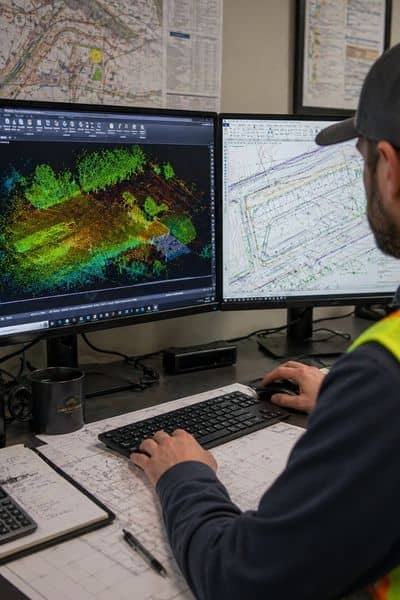
The process is simple to explain, even if it takes skill to do.
First, the point cloud gets processed. Noise and errors are reduced.
Next, key features are identified. The surveyor looks for edges, surfaces, and changes in elevation.
Then, linework is created. This includes contours, breaklines, and feature lines.
Finally, everything gets checked. The goal is to make sure the data matches real conditions on site.
The result is a clean drawing that engineers can use right away.
What You Should Ask Before Ordering Lidar Mapping
Not all lidar mapping services give the same result. Some stop at raw data. Others go further.
Before you move forward, ask a few simple questions:
Will the final deliverable include linework and contours?
Is there manual review involved?
Can the data be used directly for design?
If the answer is unclear, that’s a warning sign.
Because raw data alone won’t help your project move forward.
Why This Step Can’t Be Skipped
Lidar mapping is a great tool. It saves time during data collection. It captures detail that would take much longer with traditional methods.
But it’s only the first step.
The real value comes from turning that data into something clear and usable. That takes human judgment. It takes experience. And it takes time.
Skip that step, and the data becomes a problem instead of a solution.
Get it done right, and your project moves forward with confidence.
In the end, lidar mapping does a lot. But it doesn’t do everything.
Manual linework review is what turns raw data into something you can actually build from.